Main Information | Interactive Map | Best Time to Go | How to get there


Welcome Kit
Bariloche
Welcome Kit Digital > Destinations > Buenos Aires
Main Information
Buenos Aires is the doorway to the cosmopolitan South America and home to the Tango. Modern, dynamic and traditional, the city exhibits the mixed essence of the Argentineans.
A bohemian and energetic environment is also well kept within some memorable corners, in many typical neighborhoods and in the most sophisticated restaurants and bars spread all over the city. Known as “the Queen of the de la Plata River”, the City of Buenos Aires is characterized by having multiple artistic and cultural expressions that amaze tourists on their tours. Buenos Aires is an amazing destination waiting to be discovered.
Download this Guide
Download this travel guide to always have it available on your mobile device.
Destination Interactive Map
How to reach to Bariloche?
Bariloche is located at the Southwest area of Rio Negro Province, at the feet of the Andes Mountain Range, and it can be reached by different means of transportation, such as airplane, coach, car, train (Patagonian service) or boat (Andean crossing).
Best time to go
The best time to travel to San Carlos de Bariloche is between November and February, where the weather is nice, and with little precipitation. On the other hand, if looking to ski, the best season is between July and September.
Weather
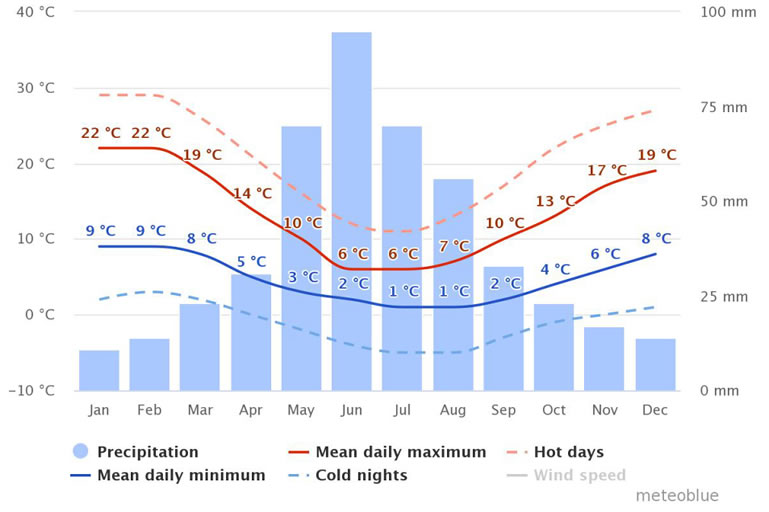
Average temperatures and precipitation
The “mean daily maximum” (solid red line) shows the maximum temperature of an average day for every month for Bariloche. Likewise, “mean daily minimum” (solid blue line) shows the average minimum temperature. Hot days and cold nights (dashed red and blue lines) show the average of the hottest day and coldest night of each month of the last 30 years. For vacation planning, you can expect the mean temperatures, and be prepared for hotter and colder days.
How the weather is?
In Argentina the weather can change a lot depending on the area where you are. That is why we share the weather forecast for the next 4 days in this destination.
What to wear?
Bariloche has truly changing weather and that is why we can find a great variety of temperatures in the same season. In that sense, in front of the question “What clothes do I put in my suitcase?”,it is important to know that a good, light windbreaker and a raincoat is essential and the best friend of everyone who visits not only Bariloche, but also Patagonia.
In the area, the climate varies greatly according to the season and the activities that a tourist will be engaged in. If a traveler is going to know, contemplate the landscape, travel, etc., without performing any sporting activity, then the informal and comfortableclothes that are worn every dayis appropriate.
Also it is always advisable to always bring a good proportion of warm clothes during any time of the year, since the winds are cold and even in summer the nights are usually cool.
For summer, light clothing is ideal, as well as a sun blocker.
Footwear must be comfortable, with a good support for the foot and suitable for walking on stones and climbs. A hat never hurts.
For specific activities such as skiing, trekking, fishing and some adventure tourism activities, the specifications are more punctual.
The practice of any winter sport requires a specific clothing, which allows us to fully enjoy the activity without feeling the bad weather.
There are endless options and brands for which you can opt, which vary in price and composition materials. If you are not a regular skier, you may want to rent the clothing and not buy it, as long as the clothing you rent is of quality.
Ideally, it should be equipped with the famous 3 layers: an interior, an insulation layer and an outer or protective layer against the harsh weather.
What to do?
We present our main ideas to enjoy the best attractions and activities of this destination.
Best things to do in the area

Nahuel Huapi Lake trips
The catamarans that make daily excursions to Victoria Island, the Arrayanes Forest and Puerto Blest sailing through Lake NahuelHuapi, are a year-round classic.
The highlight is the option that combines Victoria Island and Arrayanes Forest. Another option is to navigate to Blest Port, with the option to spend the night in forest, navigate the Frias Lake, or reach Puerto Varas in Chile – which is the incredible Andean Crossing tour.
Canopy and Hiking
Bariloche is themain city withinthe region with the greatest offer of trekking circuits for those who dare to walk through the mountains contemplating its incredible landscapes.Also, canopy is one of the adventure excursions most requestedby tourists, as it proposes another way to discover nature as a family from the canopy of gigantic trees.
Rafting
Rivers in the area go throughdeep valleys and endless forests in the heart of the Andes Mountains, and an amazing way to enjoythis unique landscape is descending on rafting rafts. If you are looking for a proposal for the whole family, the one floating on the Limay Riveris the best option due toits calm and crystalline waters, its backwaters and gentle currents, Another possibility is to navigate the Manso River, which allows you to appreciate all the beauty and magicof the Andean–Patagonian forest.Another alternative is stand up rafting: up to six people on a giant stand up paddle board, descending the Limay River.
Brewery Circuit
Bariloche has about twenty world–class craft breweries. The beer courts propose to taste smoked bites, pizzas and other delicacies, with a wide variety of draft beer.
Otto Hill
It is one of the most classic and unmissable walks in the city: nothing like going up on a cable car to the top of the hill and having tea at its 360º degree revolving tea house. During the summer the excursion allows you to see the city with unique colors of the season.
Catedral Hill
A true amusement park in nature, including activities for children and the family, self-guided trails, cable cars, chairlifts, a restaurant, trekkingand mountain bikecircuits andsporting events.During Winter (South Hemisfere) it is the main ski resort in Argentina.
Visit the beaches
The beaches of Bariloche are an excellent option for those looking to fight the summer heat. Some of the most popularare, BonitaBeach, located 8 kilometers awayfrom downtownand Centenario Beach.
Civic Center + Nahuel Huapi Lake waterfront
They are several important buildings with a similar architecture in three blocks that surround the square. There are several viewpointsto sit and take advantage of being in an incredible place, in front of the Nahuel Huapi Lake and the Andes mountain range.
Short Circuit+ Colonia Suiza and Campanario Hill
The Short Circuit runs through the main attractions and crosses two parks: the Nahuel Huapi National Park and the Llao Llao Municipal Park. It begins in the center of the city and continues along BustilloAv., bordering the the Nahuel Huapi lake.Colonia Suiza wasthe first Swiss settlement in Patagonia, where noware several restaurants and bars, mostly made of wood and with farm animals around. The most typical activity is to eat “curanto” (Wednesdays and Sundays), which is a dish cooked on a hot pit on the ground.Moreover, the view you have from the top of CampanarioHillis something spectacular.
Cerro Tronador and the “Black Snowdrift” Hanging Glacier
The Tronador Hill, an active volcano, in the southern part of the Andes Mountains, indicates the borderbetween Chile and Argentina.
Main Atractions

Cathedral Hill:
This mountain is located 19 km (12 mi) from San Carlos de Bariloche town andwithin the Nahuel Huapi National Park in Argentina. In the northeast side of this hill is located a ski resort equipped with a variety of facilities, hotels, and means of transportation for the ascension to the peak. The south side of this peak stands out for its rock formation, which resembles the shape of a gothic cathedral and gives the name to this hill. During summer (southern hemisphere), it is possible to practice rock climbing here.
Otto Hill:
This mountain (1,405 m.a. s.l. /4,600 ft), is located in the south side of the Nahuel Huapi Lake, within the Nahuel Huapi National Park. This hill got its name from one of the pioneers that owned a farm on its side: Otto Goedecke. It is possible to ascend here by either going along the road for vehicles or by taking one of the cable cartsdeparting from the neighborhood called Melipal. Depending on the slopes, Nordic skiing and Alpine skiing can be practiced on the higher areas of this mountain. “Piedras Blancas” is the name of the special area for Alpine skiing.
A 360–degree panoramic view ispossible from the top of the hill, especially tothe Nahuel Huapi Lake, Moreno Lake, Gutierrez lake, Tronador Hill, Cathedral Hill, and the Llao Llao and San Pedro Peninsulas. On top of this hill, there is also a 360° revolvingbar.
Tronador Hill:
This is an extinct volcano located on the border between Argentina and Chile, near Bariloche city. It also divides two National Parks: on the Chilean side, Vicente Perez Rosales Park and on the Argentinean side, Nahuel Huapi Park. It has a maximum altitude of 3,491 m. a. s. l.(11,453 ft), and three different peaks: the Argentinean side peak (3,200 m / 10,500 ft), the Chilean side peak (3,320 m / 10,900 ft) and a third one right on the border between these two countries (3,491 m / 11,453 ft). It was named “Tronador” (Spanish term for “thundered”) due to the sound produced by the frequent avalanches of seracs (blocks of ice) that fall from its seven glaciers. On its base, there is an area where the ice is black because of the sand and the sediments that the avalanches push down. This place is known as “Black Blizzard”. On the Argentinean side, there is a trail that allows people to go closer to the rock walls surrounding the hill and from there, it is impossible to have a clear view of the peak. To do so, it is advisable to go to “Pampa Linda”, a close spot that is crossed by the Manso River,born from streams coming from the glaciers on top of the mountain.
Puelo Lake:
It is a lake locatedin the northeast of the province of Chubut, in Argentina. Of fluvial–glacial origin, its deepest point is about 180 m (590 ft). Close to the lake, there is a town carrying the same name and the Lago Puelo National Park. Due to the beautiful landscapes surrounding the lake, 20,000 tourists visit this place every summer,so in the area, there are cabins, hotels and water sports can be practiced.
Llao Llao Hotel:
The Llao Llao Hotel is located in the tourist resort of San Carlos de Bariloche within the province of Río Negro, Argentina. This famous hotel is situated at the foothills of the Andes range, 25km (15.5 miles) away from the city, on a hill between the Moreno and Nahuel Huapi lakes.“Llao Llao” is the name of a very common species of mushroom of thisregion and it grows attached to trees like the Antarctic Beech (in Spanish, Ñire) and “Coihue” trees. Moreover, “Llao Llao” in an aboriginal language means “tasty tasty”, “sweet sweet”. The building, which has a Canadian architectural style, was made in the beginnings of 20th century out of wood, stone and Norman roof tiles. It has 173 bedrooms, 28 suites, 18 –hole golf course, spa and insulated swimming pool. The hotel was built inside the Nahuel Huapi National Lake, surrounded by lakes, mountains and forests. The landscape view from this place is magnificent and the mountains that can be appreciated from here are Lopez, Capilla and Tronador. The original hotel, designed by Alejandro Bustillo and made almost entirely of wood, was destroyed by a fire soon after it was finished in 1939. A year later, Bustillo built a new hotel out of reinforced concrete and stone. In 1979, due to the lack of funds for maintenance, it had to close. During more than 15 years, the hotel was exposed to robbery, vandalism and overall neglect. After some restoration works, it was reopened in 1993 with the name Llao–Llao Hotel & Resort Golf Spa.
The Black Blizzard:
El Ventisquero Negro is one of the seven glaciers located on the top of the Tronadorhill, in Bariloche city and it got its name from the color given by the sediments that the avalanches carry with them. This Tronador Hill is located within the Nahuel Huapi National Park and it has 3,478 m. a. s. l.(11,410 ft). It was named “Tronador” (Spanish term for “thundered”) due to the sound produced by the frequent avalanches of seracs (blocks of ice) that fall from its glaciers.
The receding glacier is fed by the constant and thunderous avalanches of ice coming from the Rio Manso Glacier, around 700 m (2,296 ft) higher on the mountain. It is possible to walk on the Ventisquero Negro glacier without having any previous experience, but with the company of an authorized tour guide and the wearing of crampons.
Blest Pier
This is a small port located on the Nahuel Huapi Lake, from whereseveral trails departandthatallow tourists to visit this part of Nahuel Huapi National Park together with the bay. To get to this port, it is necessary to take a boat in Pañuelo Pier, located in the Llao Llao Peninsula, and sail 18 km (11miles) along a branch of the lake.
Andean Lake Crossing:
The Andean Lakes Crossing is the most scenic way to travel from Argentina to Chile, o viceversa. This spectacular crossing of the Andes lakes you through lakes and mountain passes that can either be made from Bariloche (Argentina) to Puerto Varas(Chile)or from Puerto Varas to Bariloche. It operates all year round and the crossing includessailing along three lakes: The Nahuel Huapi lake, Frias Lake and Todos los Santos lake, as well 3 different bus rides. All in all, it takes about 12 hours, one way, so you can definitely consider this a tour, not just a transfer from one side ofthe border to the other.
El BolsónVillage:
El Bolsón is a village located in the far southwest of Río Negro Province in the Argentinean Patagonia. It has an unusually temperate climate for its southern location and is surrounded by a mountain landscape, full of pine trees, rivers and lakes. This town is located at the foot of the Pilquitron Hill (name that means “hanging on the clouds”) on a deep valley that goes from north to south and is crossed by two rivers: Azul and Quemquemtreu.
Mascardi Lake:
This lake is close to Bariloche city and it has a maximum length of 23 km (14 miles); a maximum width of 4 km (2.5 miles), and a maximum depth of 218 m (700 ft).
The name of the lake comes from the last name of a Jesuit priest, Nicolás Mazcardi, who established a Jesuit mission on the Nahuel Huapi Lake shores, duringthe second half of 17th century. It is allowed to sail and fish in the lake, especially salmon trout, which feeds and seeks shelter on the bays of the lake.
Nahuel Huapi Lake:
The Nahuel Huapi is a glacial lake located in the lake region of northern Patagonia, within the Nahuel Huapi National Park, between the provinces of Río Negro and Neuquén, in Argentina. It has a surface of 557 km² (215 sq mi)and it is700 m. a. s. l. (2,297 ft). The lakeoutstands for its depth (438 m / 1,437 feet) and for its seven branches. It is also connected to other smaller lakes and its deep–blue waters hold a number of islands, most notably Victoria Island with a surface of 31 km² (12 mi²).The first Europeans that visited the lake came in 1670 and they were Jesuit missionaries whose main purpose was to evangelize the natives. In 1718 the mission was abandoned due to the slaughter of five members of their religious order. Almost two centurieslater, in 1876, the Licensed Audit Expert named Francisco Pascasio Moreno sailed the Limay river and got to the east coast of this lake.
Moreno Lake:
This lake is located close to Barilochecitywith a surface of about 1,640 ha (4,052 acres)on the coasts around the lake, there are located two towns: Colonia Suiza(Swiss Town)and Llao Llao. One unusual characteristic of this lake is that it is divided into two smaller portions. Each of these parts gets a different name depending on its location: the Western or Inferior Moreno Lake and the Eastern or Superior Moreno Lake. The narrow branch of the lake connecting these two portions is crossed over by a bridge and it is visited on a tour named “Short Circuit”which goes around the Western Moreno Lake completely. A large portion of the coasts around the lake are in private hands and only a small area in the west side of the Western Moreno Lake belongs to the Llao Llao Municipal Park. Compared to other lakes, the water in this one is more temperate due to the fact that it does not depend mainly on the melting of glaciers, but on winter and spring rains. This characteristic makes this lake one preferred spot to practice water sports like swimming, sailing, windsurfing and stand up paddling.
Gutierrez Lake:
This glacial–origin lake is located in a valley surrounded by the Otto, Catedral and Ventana Hills. Forests full of “cohiue” trees surround the lake and a vast portion of that land belongs to the Nahuel Huapi National Park. Compared to other lakes, the water in this one is more temperate due to the fact that it does not depend mainly on the melting of glaciers, but on winter and spring rains. This
characteristic makes this lake, together with Moreno Lake, one of the most preferred spots topractice watersports.
Los Arrayanes National Park
Los Arrayanes National Park was created in 1971 on the Quetrihué Peninsula, on the shoresof the Nahuel Huapi Lake, 3 km (1,9 miles) from Villa la Angostura town.The aim of this park is to protect its forests full of rare “Arrayán” trees (Luma apiculata), the soil and the roots of these fragile trees. For this reason, a path has been made for tourists to enjoy the view of the cinnamon–coloredtrees. This path, full of ups and downs,and ispopular for the practicing of mountain biking.Even though thesetrees can be seen on the way to the end of the peninsula, the forest of 300 year old specimenscovers 20 ha (50 acres) of the southern point, with some individuals withover 600 yearsold. The forest canbe reached by boat from different points of the Nahuel Huapi Lake, or via a12 km (7.5 miles) path from the beginning of the park, nearby La Angostura Village.
Nahuel Huapi National Park
This park is the oldest Argentine national park, located in Patagonia in the foothills of the Andes, established in 1934, but the nucleus of the park is the land donated to the federal government by the Licensed Audit Francisco Moreno in 1903.The park covers approximately 705,000 ha (1,742,093 acres), bordering with Chile, and the largest city and touristic resort within the park is the city of San Carlos de Bariloche. Villa La Angostura is another lakeside resort also within the boundaries of the park.The park is famous for its rich wildlife and it covers many biotopes, due to altitudes ranging from 700 to 3,000 m (2,297 ft to 9,843 ft). Bordering the National Park to the north is the Lanín National Park.
Villa La Angostura
This town is located in the south of Neuquen Province, within the Nahuel Huapi National Park and enclosed by lakes, forests and mountains. Villa La Angostura, together with San Carlos de Bariloche and San Martin de losAndes, are considered to be some of the prettiest Andean towns in the south of Argentina. Moreover, they all form part of a very touristic area during both, summer and winter seasons.
Traditional Gaastronomy of the Region
In Bariloche the gastronomy option is very varied. The cuisine has managed to blend the most representative of European cooking with the best of regional dishes. Classic recipes receive additional touches such as the taste of pine mushrooms, fine fruits and all kind of berries that make any recipe a specialty. Bariloche also offers the tourist a number of pubs, snack bars, pasta and pizza, as well asinternational and regional cuisine restaurants.

Swiss and German Influence
In Bariloche you can see the strong influence of the early German and Swiss settlers in the local cuisine. Bariloche offers a large selection of restaurants, where you can taste regional dishes such as Patagonian lamb, wild deer and alpine traditional cuisine such as goulash or fondue
Hand Crafted Beer
There are a number of very popular boutique breweries where you can try a large variety of hand crafted beer. The beer is often accompanied with the typical Argentine “picadas”consisting of chopped pieces of smoked meats, cheeses and other ingredients that are a special delight for the palate.
Tea houses
‘The tea houses’ are another icon of the city. They offer delicious cakes, hot chocolate, homemade breads and sweets that are part of the ‘snack’ tradition in Bariloche. The tea houses often have spectacular mountain and lake views which create an unforgettable ambience.
Fruits and chocolates
The area produces a large varietyof different berries fruit that enable the production of liqueurs, jams and regional sweets. Local made fresh berry ice creams isalways a popular treat!
Curanto
Native Indian tribes like the Mapuches and the Araucanos have had a profound influence on the Patagonian region. The curanto (a term standing for hot stone) is a typical dish that has its origins from these native Indian tribes.The cooking process starts by digging a pit in the ground. River stones are then placed on top of a roaring fire. Once the stones are heated, they are then removed from the fire and placed in the pit. A bed of leaves is arranged on top of the stones. A selection of meats and vegetables are then stacked on top of the leaves.The food that goes into the curanto typically includes beef, lamb, pork, chicken, chorizos (pork sausages), potatoes, sweet potatoes, apples and hollowed out pumpkins stuffed with cheese, cream and peas. The food is then covered with leaves and damp sheets to keep the heat from escaping. The final step is to cover the damp sheets with soil. This results in turning the whole cooking process into something that resembles a pressure cooker.After a couple of hours, smoke and steam start billowing out of the ground. The end result is a delicious meal with its own uniqueness which includes a hint of smoke and a slight earthy flavor. You can experience the curantoevery weekend at Colonia Suiza for an unforgettable not to be missed lunch.
Fish and meat
Mouth–watering salmon and trout, plentiful in the Patagonian lakes and rivers, are eaten fresh as well as smoked and accompanied by a range of different sauces.For the connoisseurs of meat, Patagonian lamb is a national delicacy. Lamb, wild pig and alpine venison are all very popular and highly appealing local dishes.Of course you will find a large variety of classic dishes like parilla grilled meat, homemade pizza and Italian style pasta dishes that are found throughout Argentina.